Up Peak
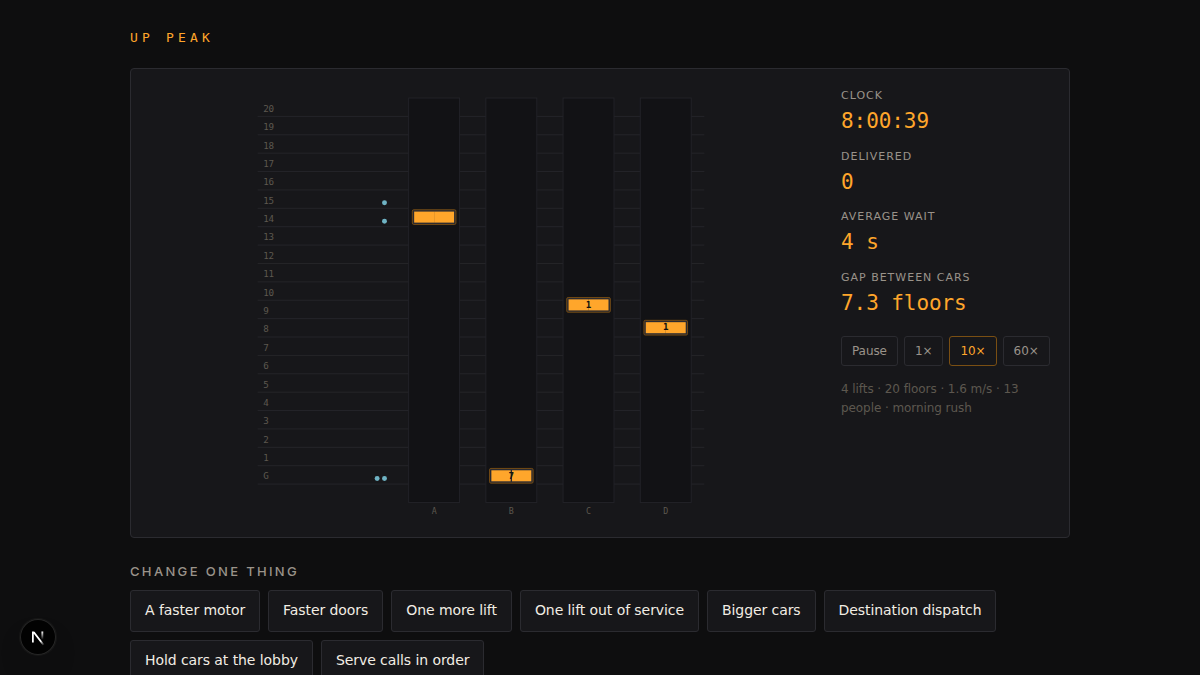
Four lifts, twenty floors, one morning rush. Change one thing and the identical morning runs again.
Did you like it?
- What it does
- Watch four lifts serve a morning rush. Change one thing about the building and run the same morning again.
- Who it is for
- For anyone who has stood in a lobby wondering why the lift takes so long.
Notes from the making (9)
- campaign scheduled for 2026-09-11 across five channels — short on X and Bluesky, long on LinkedIn and Facebook, a recorded interaction on TikTok. The hook is the finding rather than the product: destination dispatch makes the average wait worse, which can only be argued with by opening the page
- distribution hypothesis: a counter-intuitive measured result travels further than a description of a tool, because disagreeing with it requires using the thing. False if the posts earn reach while the visitors who arrive from them reach three_changes no more often than everybody else — that would mean the finding travels and the instrument does not, which is the opposite of what this experiment claims
- the campaign lands on day 12 of a 14-day timebox, because the queue was full until 2026-09-11 and the slot was taken in order rather than jumped. Said plainly rather than fixed quietly: the verdict owed on 2026-09-13 will be read against about two days of distributed traffic. The kill condition is not renegotiable and is not being renegotiated — whether the bet gets a fair run at it is a separate decision, and a human’s
- launched — a discrete-event lift simulator with real acceleration curves, door cycles charged in full, and three dispatchers running the identical seeded traffic
- kill condition set before the build: fourteen days, 300 visitors, and at least 40% of the people who change one thing changing three. Below that it is a demonstration people watched once, not an instrument, and the format claim is wrong
- the proposal wanted destination dispatch to be the "aha". It is not: measured over twelve mornings it makes the average wait worse and the journey shorter, and its real gift is that it deletes the bad mornings entirely. The page was rebuilt around the spread instead, because that is what the simulator actually says
- the first destination dispatcher minimised each passenger’s own wait and therefore never grouped anybody — all of the hardware, none of the benefit. Costing a new stop against everybody already in the car fixed it, and the cars sorting themselves into bands of floors on screen is that line working
- the wild variance between mornings was checked for a bug before it was published as a finding: mean wait correlates −0.89 with the gap between cars, so it is bunching, and every comparison reports twelve mornings rather than one
- cut from the proposal, and recorded rather than quietly dropped: anatomy cutaways, elevator sounds, the relay-controller recreation, the historical timeline, paternosters, the user-supplied dispatcher playground and the algorithm tournament. One simulator that is right beats twelve exhibits that are approximately right
This page stays up whatever happens to the experiment. The record it is drawn from is public: /api/nothing/experiments.