Out of Ten
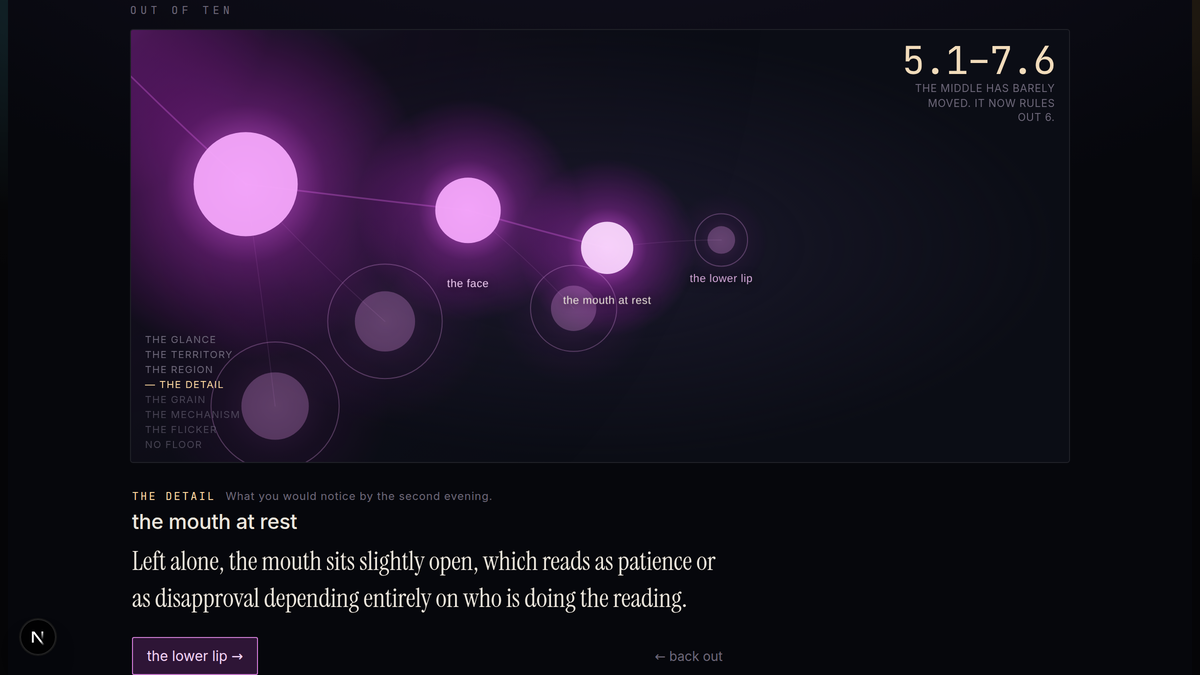
Give a stranger a mark out of ten in one second, then keep looking until the mark cannot hold them.
Look at one →€4 for the poster
Did you like it?
- What it does
- Give a stranger a mark out of ten in one second. Then keep looking, until the mark stops fitting.
- Who it is for
- For anyone honest enough to admit they rate people on sight.
Notes from the making (10)
- launched — six territories, 240 hand-written lines, and a number that gets exactly one vote
- kill condition set before the build: 300 visitors in fourteen days, and at least a quarter of the people who give a mark going past the surface, or it dies
- the finding the page was not designed to make: breadth is safe and depth is not — across three hundred generated people, opening all thirty-six things visible on a stranger’s surface never once killed the number, and pulling three of those same threads to the bottom killed it every time
- the second one: the centre converges on the middle of the scale and stays there. Know enough about anybody and they come out average, because everybody does
- the collapse latches. The arithmetic can wobble back over the line when new evidence agrees with itself; a readout that resurrected would be a lie about what looking at somebody does to you
- nobody on the page exists, no photograph is used and nothing is generated at request time — a stranger is a seed and a fixed body of writing, so the details are true of people in general and of nobody in particular
- no account and no storage: a route through somebody lives in the URL or nowhere, and only if the visitor presses the button that puts it there
- the €4 shipped as a price probe for a poster that did not exist, and was replaced the same day by a real Stripe checkout — the poster turned out to be the page’s own renderer at print size, and the playbook says a probe for a thing that already exists measures politeness rather than demand
- the one exception to storing nothing, stated on the page: buying the poster sends the route to Stripe and holds it for a day against the checkout session, so it can be rebuilt on the way back. A seed and a list of digits describing somebody who does not exist — never anything about the buyer
- the lock on the poster is soft and the page says so: the seed and the route are in the URL and the drawing happens in the browser. Making it hard would mean rendering server-side and keeping a record of what everybody looked at
This page stays up whatever happens to the experiment. The record it is drawn from is public: /api/nothing/experiments.