On Me
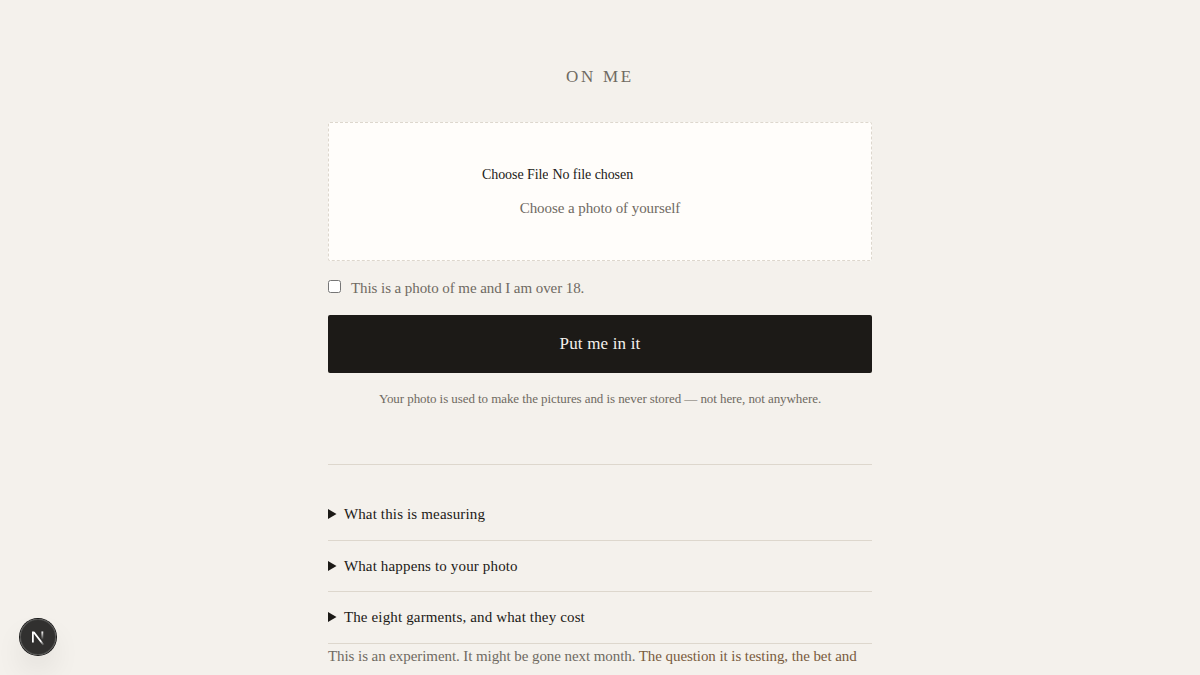
One photo in, and eight ordinary garments come back — four on a model, four on you, shuffled and never side by side. The page counts which ones you said you would wear.
Did you like it?
- What it does
- One photo of you. Eight ordinary garments come back, four on a model and four on you, and the page counts which you would wear.
- Who it is for
- For anyone who has never once looked like the model.
Notes from the making (9)
- the idea arrived as Dress Me, a visual personal-style compiler: 3–8 photos, twelve looks across seven occasions, transformations, and a €250 basket built from live retail and second-hand inventory. It tripped both of the conditions /validate-idea says to stop on, so most of it was cut before anything was built
- the arithmetic that did the cutting: the free tier generated images per visitor, so cost rose with success against a €20 ceiling. At any per-image price between €0.02 and €0.15, eight looks each buys between 16 and 125 visitors — and the comparable kill condition in this portfolio is 300. The instrument could not reach the reading it existed to take
- the basket builder needed live inventory and affiliate approval from companies who have agreed to nothing, which is the second stop condition. Deleted rather than deferred politely
- kill condition set before the build: 300 visitors, and the personalised arm must beat the model arm by at least 20 percentage points on "I’d wear this". Below that, the claim that personal simulation beats recommendation is not worth building a wardrobe engine on, and we say so plainly
- built: one page, four routes, eight garments fixed in version control, four generations per visitor behind a €15 ceiling enforced in code, and a €5 checkout on the Sieve pattern. No dependency was added — the provider was already in the manifest
- the control arm changed during the build. It was going to be stock photography and is now generated by the same renderer from the same prompt with only the body swapped, because photographing one arm and generating the other confounds the comparison with a second difference and leaves it unable to say which one moved the verdict
- the tests caught the spend ceiling failing: the in-memory fallback incremented the counter and then refused the claim without handing the money back, so a deployment without Redis would have climbed past €15 and locked itself shut early. This is the first page here whose marginal cost rises with success, so that guard is the reason it is allowed to exist at all
- not verified, and recorded rather than smoothed over: the sandbox this was built in cannot reach the image provider — 403 on CONNECT, no key — so not one image was generated during the build. The renderer is written against the API contract and has never run
- no attention ask is declared, so it reads UNDECLARED. The page wants to claim 90 seconds at `memorable`, and seeing yourself in clothes you never put on is memorable if it works and faintly insulting if it half-works. That claim cannot be made from a brief, so distribution is held until a human runs the likeness on five faces. If it does not obviously read as them, this dies at build cost
This page stays up whatever happens to the experiment. The record it is drawn from is public: /api/nothing/experiments.