Done
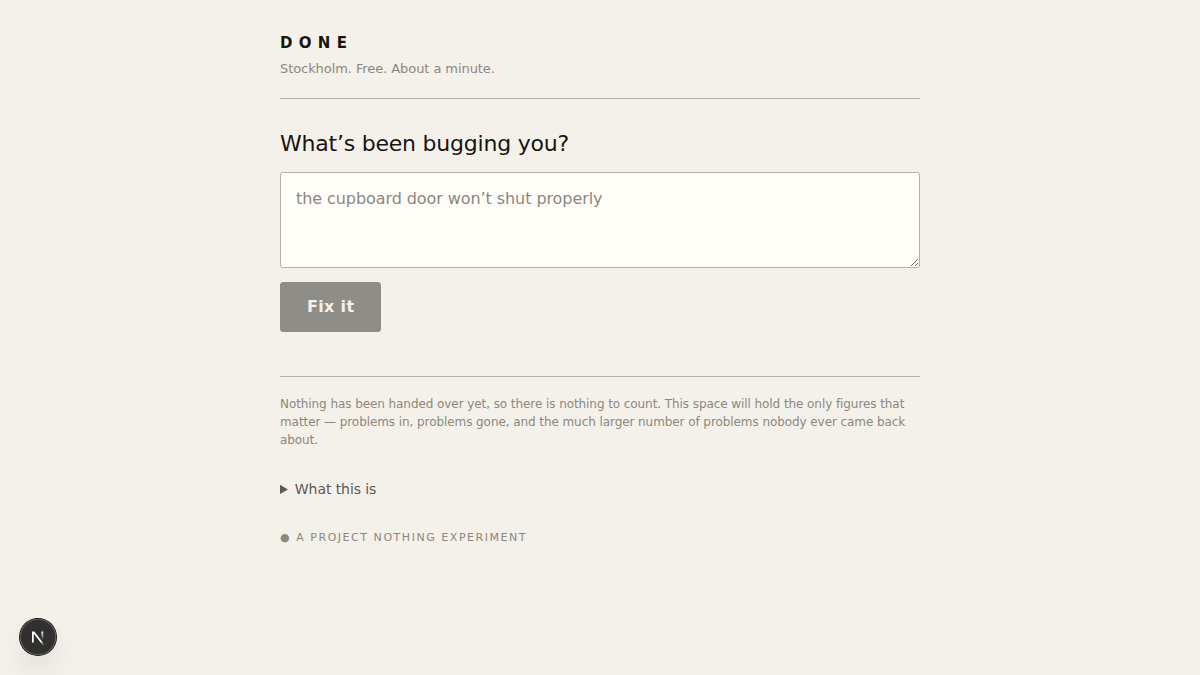
Tell it the thing that has been mildly annoying you for a month. One costed route, one part, a date — then it comes back to ask whether it worked.
Did you like it?
- What it does
- Describe one household problem you have been ignoring. Get one costed route, one part and one date, then a check-in.
- Who it is for
- For people in Stockholm with a month-old nag on the list.
Notes from the making (6)
- launched — a repertoire of sixteen Stockholm household situations, each costed across the ladder from doing nothing to paying somebody, and a planner that picks one
- kill condition set before the build: fourteen days, fifty problems handed over and ten confirmed resolved. Ten of fifty is deliberately harsh, because a completion engine that cannot show completions is an answer engine with better typography
- the model is not allowed to price anything. It may pick an id from a fixed list and pull out constraints somebody volunteered; every figure comes from a hand-checked table in version control with a date and a basis on it. A plausible price from a language model is worse than no price, because somebody goes to the shop on it
- questions are only asked when the recommendation genuinely differs across the answers. Seven of the sixteen situations ask nothing at all; the tenure question fires on six, because in a Swedish rental a sticking cupboard door is the landlord’s, free, and almost nobody reaches for that
- the refusal boundary is in code rather than in a prompt — gas, mains wiring, water inside a wall, structural. It names felanmälan, the BRF or 112 instead of declining and leaving somebody holding the problem
- resolution is self-reported and requires a return trip, so it is published as a floor rather than a rate: problems nobody comes back about are counted as unknown, in a column the same size as the other two, and never moved into either
This page stays up whatever happens to the experiment. The record it is drawn from is public: /api/nothing/experiments.